

Lowell Clark Pratt
The Selma (Calif.) Enterprise, Selma
1894-1979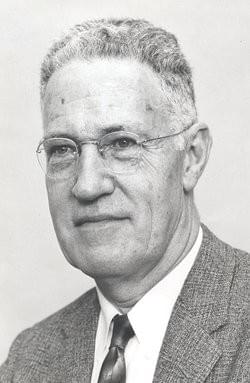
Lowell Clark Pratt was a journalist, teacher, and in 1947, became the first public relations director at what was then San Jose State College (now University). After graduation from high school in 1913 he was hired to cover local news for the Pomona Progress, and he continued working there while attending Pomona College. In the fall of 1915, he entered the Columbia University School of Journalism.
His education was interrupted by World War I. During the war, he served 18 months in the army, including seven months of non-combat duty in France. He was a corporal and clerk of company B, 160th infantry. Later he was promoted to first sergeant.
After the war, he continued his studies at Columbia, graduating in June 1920. He worked for two months on the Springfield (Mass.) Republican before returning to California to accept a position as city editor of the Pomona Progress. In 1923 he joined the staff of the Pasadena Star-News.
In 1926 he bought The Selma (Calif.) Enterprise. With a young man named Ernest Rapley, he plunged into the life of a small town and had to learn facets of newspaper publishing which were new to him, such as job printing, advertising, circulation and promotion. In February 1929, The Enterprise was consolidated with the other Selma paper, The Irrigator, and Pratt was co-owner. In June 1929 the partners bought the Parlier Progress, and the Fowler Ensign was purchased in the early ’30s. The commercial printing operation was christened the “Triangle Press.”
In August 1931 a fight broke out between a group of white youths and Filipino grape pickers. Although the whites admitted to starting the fight, only the Filipinos were charged and fined. In an editorial called “Dollar Justice,” Pratt criticized the judge’s handling of the case. The judge cited him for contempt of court; the charge, however, was dropped a few days later.
Because of his stance that a judge is a public servant and should not be immune from public criticism, he was placed on the all-American journalism “team” of John H. Casey of the University of Oklahoma as editorial writer of the year in 1932. The newspaper also gained recognition in 1936 when it won a front-page contest for weeklies, sponsored by the California Newspaper Publishers Association.
He was appointed Selma’s postmaster in May 1934. On Christmas mornings he volunteered to deliver packages. He resigned as postmaster in October 1939.
During World War II, Pratt opposed the relocation of Japanese-Americans to internment camps. He also spoke out for their safe return after the war had ended.
The Enterprise was one of the few newspapers in the west that stood up for the rights of Japanese-Americans. Pratt emphasized that Americans of Japanese ancestry were law-abiding U.S. citizens and, as such, had constitutional rights. His editorials were a voice of reason during a time of anti-Japanese hysteria.
In August 1943, Pratt testified before a committee appointed by the California State Senate. Pratt felt anti-Japanese sentiment was racially motivated and emphasized that the vast majority of Japanese-Americans were loyal. Because of Pratt's editorials on Japanese-Americans, Dr. Hubert Phillips, a teacher at Fresno State College, nominated him for a Pulitzer prize in journalism in 1943.
In March 1947, with his partner wanting to retire, the Enterprise was sold. In September 1947, Pratt became the first director of public relations at San Jose State College. He also taught journalism classes there, until 1956. He retired from San Jose State College in 1965.
In 1968 he moved to Wheaton, Md., where they could be near their daughter. He died in 1979.
Lowell Pratt was an honest, hard-working man who had high ideals and put them into practice. He was outgoing, always friendly and interested in people and well-liked by others.
At his memorial service, a telegram from a former student was read. It said, in part: “Probably no single person has influenced my professional life more than a journalism professor named Lowell Pratt, whom I met in 1947 ... Lowell Pratt was the kind of teacher you never forget: intellectually quiet, patient, disciplined, thoroughly professional ... As a teacher of writing, Mr. Pratt tried to teach us to be factual, accurate, interesting, and concise …”
*Hall of Fame inductees are selected annually by a committee appointed by the California Press Foundation. They recognize career achievements of weekly and daily publishers in California who were important and influential in their era, as judged by their peers in the association. The write-ups are a historical and journalistic snapshot in time and not official biographies.*
